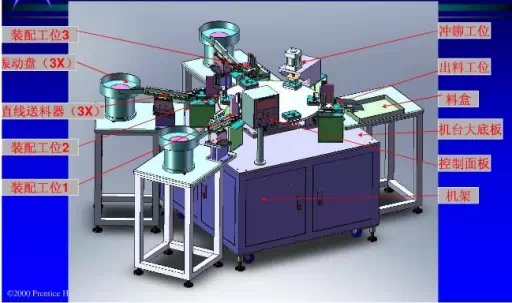
As the core carrier of Industry 4.0, automatic assembly machines and automated assembly production lines are deeply reconstructing production modes in fields such as medical equipment, military industry, and small home appliances through high integration, flexible design, and intelligent programming capabilities. This is reflected in the following technological innovations and industrial value:
Core technology breakthrough
Multi process integration and variety compatibility: Adopting modular design, it can be equipped with composite functions such as locking screws, soldering, dispensing, handling, and assembly. By replacing fixtures or adjusting programs, it can quickly switch between multiple types of components. For example, the small household appliance production line can be compatible with different types of palletizing, loading and unloading, and partitioning processes, solving the flexible production needs of "multiple product models and small single batch sizes".
Intelligent programming and rapid deployment: The robot body can quickly complete parameter configuration such as trajectory planning and force control adjustment through graphical programming or offline programming technology, achieving "secondary deployment" of the production line. Compared to traditional screw locking machines, which are limited by flat tasks, large footprint, and difficult secondary deployment, automatic assembly machines can flexibly adapt to three-dimensional space operations and shorten the production line transformation cycle.
High precision and stability: Through visual guidance, force feedback, laser positioning and other technologies, the accuracy consistency of screw locking, soldering and other processes is ensured. For example, in the home appliance industry, traditional manual or standard screw locking machines are prone to problems such as missing locks and slipping teeth, while automatic assembly machines can achieve a locking accuracy of ± 0.02mm, improving product yield.
Industry application value
In the field of medical devices, for precision component assembly (such as syringes and catheters), automatic assembly machines can achieve micrometer level operations in sterile environments, reduce the risk of manual contamination, and meet the requirements of FDA and other regulations for production process traceability.
In the field of military products: In scenarios such as ammunition assembly and radar component assembly, automatic assembly machines can replace manual labor to complete high-risk, high-precision tasks, improve production safety and consistency, and meet the quality standards of "zero defects" for military products.
In the field of small household appliances: In response to the production characteristics of "multiple varieties and small batches", automatic assembly machines can quickly switch between different types of loading and unloading, locking screws and other processes through flexible design, solving the problems of low efficiency and quality fluctuations caused by traditional production lines relying on manual loading and unloading. For example, after a household appliance company introduced an automatic assembly line, the manual labor on a single line decreased by 60%, the production efficiency increased by 40%, and the product defect rate decreased to below 0.5%.
Economy and investment return
Reduce labor costs: By replacing repetitive manual operations, reduce reliance on skilled workers, and alleviate labor shortages. For example, in the small household appliance industry, labor costs account for a high proportion, and automatic assembly machines can significantly reduce labor costs per unit product.
Improving return on investment: Although the initial equipment investment is high, the increase in output and quality brought about by high efficiency and stability can quickly recover costs. For example, after a certain automotive parts company introduced automated assembly lines, its annual production capacity increased by 50%, and the investment payback period was shortened to 2 years.
Flexible production and rapid response: Faced with the increasing variety of new products and rapidly changing market demand, automatic assembly machines can achieve rapid restructuring of production lines through modular design and fast programming, meeting the flexible production needs of "small batches and multiple varieties" and improving the market response speed of enterprises.
Future Development Trends
Integration of AI and big data: By introducing machine learning algorithms, automatic assembly machines can achieve adaptive parameter adjustment, predictive maintenance, and other functions, further improving production efficiency and equipment utilization.
Digital twin and virtual debugging: By using digital twin technology to build a virtual production line, process validation and program optimization can be completed before actual deployment, reducing on-site debugging time and lowering implementation risks.
Green manufacturing and energy conservation: By optimizing equipment design, adopting energy-saving motors and intelligent energy management systems, automatic assembly machines can achieve low-carbon production processes, which is in line with the global trend of green transformation in the manufacturing industry.
In summary, automatic assembly machines and automated assembly production lines are becoming a key driving force for the transformation and upgrading of the manufacturing industry through technological innovation and mode innovation. While improving production efficiency, product quality, and return on investment, they are also promoting the development of the industry towards high automation, high flexibility, and intelligence.
● 非標自動化設備
● CCD視覺檢測系統
● 螺絲擰緊機系列設備
● 涂油涂膠系列設備
● 氣密檢測系列設備
● 自動組裝裝配系列設備
● 耐久疲勞測試系列設備
● 電性能測試系列設備
● 自動焊接系列設備
● 沖壓壓機系列設備
● 航空配件系列設備
● 全自動生產線系列設備
● 各類工裝夾具、零部件加工
O型圈自動裝配機:
*用于對活塞柱的外圈進行O型密封圈套裝作業;
*臺面的工裝夾具可快速更換,以滿足匹配各類不同的產品;
*加裝有對射保護光柵,對現場操作作業進行防護;
*MITSUBISHI PLC控制系統/觸摸屏人機界面;
*配件均采用SMC原裝氣動元件;
*THK滑軌,直線模組采用S136精磨而成;
*其它電子配件均采用行業知名品牌產品;
*此類設備可根據您的具體要求設計定制,我們將提供更多技術支持,歡迎來電垂詢!

零部件定向排列、輸送、擒縱系統 將雜亂無章的零部件按便于機器自動處理的空間方位自動定向排列,隨后順利輸送到后續的擒縱機構,為后續的機械手的抓取做準備。2. 抓取-移位-放置機構 將由擒縱機構定點定位好的零(部件)抓住或用真空吸住,隨后移動至另一位置(通常為裝配工作位置)。


3. 裝配工作機構 指用來完成裝配工作主動作的機構,如將工件壓入、夾合、螺聯、卡人、粘合、焊接、鉚合、粘合、焊接于上一零部件。4.檢測機構 用來對上一步裝配好的部件或機器上一步工作成果進行檢測,如缺零件檢測、尺寸檢測、缺損檢測、功能檢測、清料檢測。5. 工件的取出機構 用來將裝配好的合格部件、不合格部件從機器上分類取出的機構。

歐贊智能科技(蘇州)有限公司,,軍工自動化非標裝配, 智能非標自動化裝配,汽車精密零部件自動裝配生產線,自動化精密裝配 , 軍工自動化非標裝配生產線,自動化精密裝配零部件, 智能制造精密裝配,航空軍工精密裝配自動化,軍工精密制造自動化裝配,零部件精密裝配自動化,精密自動化非標裝配組裝機,汽車精密零部件裝配自動化,智能非標自動化裝配,醫療器械自動化組裝,自動化精密機械加工裝配,精密裝配非標自動化運用,軍工產品精密裝配,