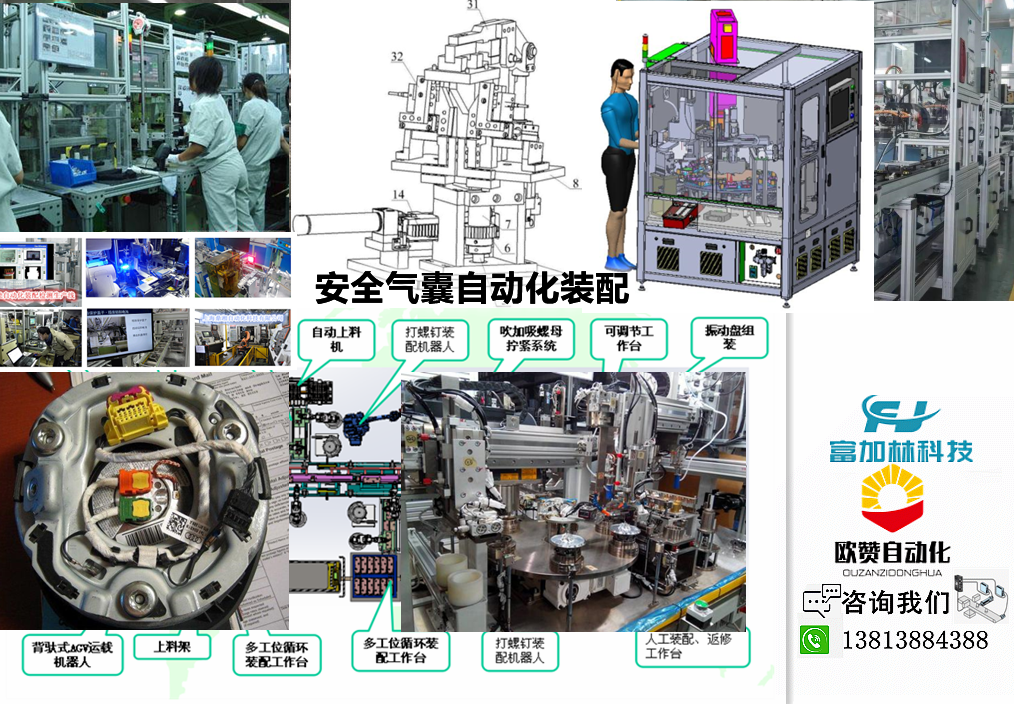
安全氣囊裝配測試生產線是汽車安全系統的核心制造環節,需通過精密工藝、嚴格測試及全流程質量控制確保產品可靠性。以下從生產流程、關鍵技術、測試標準、質量控制及未來趨勢五方面系統解析:
一、生產流程與關鍵技術
零部件準備與裝配
防錯工裝系統:采用步進電機驅動的取線防錯工裝、穿線防錯模塊及CCD視覺檢測系統,確保端子精準插入(如氣囊ECU護套防錯模塊通過水平/垂直探針控制端子插入路徑,誤操作時探針剛性頂住端子無法插入)。
自動化設備:集成全自動高精度插針機、氬弧焊機、激光位移傳感器及在線打碼/貼標/掃碼系統,實現從送本體、插針、焊接到數據追溯的全流程自動化(如蘇州市全力自動化科技有限公司的產線產能達10PCS/MIN,良率99%)。
模塊化設計:支持多型號產品一鍵切換,工位獨立調試,載具移位式機構保障線體節拍穩定性。
折疊與密封工藝
二、測試標準與設備
國家標準與測試項目
專業檢測設備
靜態測試臺:集成壓力傳感器、流量計及溫度控制系統,測試充氣時間(通常≤30毫秒)與壓力衰減曲線。
動態碰撞臺架:搭配假人模型(如Hybrid III)測量頭部/胸部傷害值,驗證氣囊保護效果。
環境模擬艙:可模擬-40℃~+85℃極端溫度及95%濕度環境,測試密封件與電子元件的可靠性。
非破壞性檢測:X射線檢測織物斷線、光譜分析金屬裂紋,確保原材料無缺陷。
三、質量控制措施
全流程追溯
生產環境控制
多級檢驗體系
在線檢測:CCD視覺系統實時檢測端子插入位置、焊點質量及氣囊折疊尺寸。
半成品檢驗:測試氣體發生器點火性能、控制器信號傳輸穩定性。
成品檢驗:靜態爆破測試驗證充氣時間與壓力,動態碰撞測試評估保護效果,環境老化試驗模擬車輛全生命周期條件。
四、未來發展趨勢
智能化與協同化
材料創新與環保
多樣化與定制化
總結:安全氣囊裝配測試生產線通過自動化設備、精密工藝、嚴格測試及全流程質量控制,確保產品符合國際/國家標準,未來將向智能化、環保化及多樣化方向發展,為駕乘人員提供更可靠的安全保護。
The airbag assembly and testing production line is the core manufacturing process of automotive safety systems, which requires precision craftsmanship, strict testing, and full process quality control to ensure product reliability. The following is a systematic analysis from five aspects: production process, key technologies, testing standards, quality control, and future trends:
1、 Production Process and Key Technologies
Preparation and assembly of components
Error prevention tooling system: using a stepper motor-driven wire taking and threading error prevention tooling, a threading error prevention module, and a CCD visual inspection system to ensure accurate terminal insertion (such as the airbag ECU sheath error prevention module controlling the terminal insertion path through horizontal/vertical probes, in case of misoperation, the probe is rigidly pressed against the terminal and cannot be inserted).
Automation equipment: Integrated with fully automatic high-precision pin insertion machine, argon arc welding machine, laser displacement sensor, and online coding/labeling/scanning system, achieving full process automation from body feeding, pin insertion, welding to data traceability (such as Suzhou Quanli Automation Technology Co., Ltd.'s production line capacity of 10PCS/MIN, with a yield rate of 99%).
Modular design: supports one click switching of multiple models of products, independent debugging of workstations, and a carrier displacement mechanism to ensure the stability of the line's rhythm.
Folding and sealing process
The folding of airbags requires control over size and force, using specialized folding fixtures in conjunction with servo systems to ensure no damage during deployment; The sealing components need to undergo high and low temperature cycling tests (-40 ℃~+85 ℃) and vibration tests (20Hz~2000Hz) to avoid gas leakage.
2、 Testing standards and equipment
National standards and testing items
Following GB/T 31450-2015 "Test Methods for Automotive Airbags", the test items include:
Static testing: explosion time (10-20 milliseconds after collision), inflation pressure (peak 340kPa), electrical performance (electromagnetic compatibility, power supply voltage stability).
Dynamic collision test: Simulate frontal/side collision (such as 40% offset collision), different vehicle speeds (20km/h~100km/h), and the unfolding logic under passenger sitting posture (child seat, driver leaning forward).
Environmental durability: high and low temperature cycling, humidity (95% RH), vibration, salt spray testing to verify material weather resistance and electronic component stability.
International standards such as FMVSS 208 in the United States and ECE R94 in Europe require an escape space of ≥ 120mm after airbag deployment, and a 60% reduction in neck stress on children.
Professional testing equipment
Static testing bench: integrates pressure sensors, flow meters, and temperature control systems to test inflation time (usually ≤ 30 milliseconds) and pressure decay curves.
Dynamic collision test bench: Use a dummy model (such as Hybrid III) to measure head/chest injury values and verify the effectiveness of airbag protection.
Environmental simulation cabin: capable of simulating extreme temperatures ranging from -40 ℃ to+85 ℃ and a humidity of 95%, to test the reliability of seals and electronic components.
Non destructive testing: X-ray detection of fabric breakage and spectral analysis of metal cracks to ensure that the raw materials are defect free.
3、 Quality control measures
End-to-end traceability
By using QR code/RFID to record production batches, assembly vehicle information, and key process parameters (such as sewing tension and welding temperature), a complete traceability chain from raw materials to finished products can be achieved.
The quality traceability system uploads real-time data to the cloud, supporting rapid recall and isolation of problematic products.
Production environment control
The assembly workshop needs to be a dust-free and clean environment with strict temperature/humidity control (such as 22 ℃± 2 ℃, 55% RH ± 5%) to avoid dust affecting the performance of electronic components.
Implement equipment preventive maintenance plan, regularly calibrate sensors and testing instruments to ensure testing accuracy.
Multi level inspection system
Online detection: CCD vision system real-time detects terminal insertion position, solder joint quality, and airbag folding size.
Semi finished product inspection: testing the ignition performance of the gas generator and the stability of the controller signal transmission.
Finished product inspection: Static blasting test verifies inflation time and pressure, dynamic collision test evaluates protection effect, and environmental aging test simulates the full life cycle conditions of the vehicle.
4、 Future Development Trends
Intelligence and Collaboration
Integrate artificial intelligence algorithms to automatically adjust the airbag deployment force and angle based on the passenger's body shape/sitting posture; Linkage with auto drive system to predict collision risk in advance and trigger protection.
Develop specialized airbags for special scenarios (such as off-road/snow driving) to enhance targeted protection capabilities.
Material Innovation and Environmental Protection
Using high-strength and lightweight materials (such as silicone coated nylon) to enhance deployment speed and stability; Use environmentally friendly materials to reduce production pollution and optimize processes to reduce energy consumption.
Promote the design of recyclable airbags to reduce waste emissions.
Diversification and Customization
Meet personalized needs (such as customized interior space layout), integrate multifunctional systems (such as seat adjustment, environmental control), and enhance user experience.
Summary: The airbag assembly and testing production line ensures that products comply with international/national standards through automated equipment, precision processes, strict testing, and full process quality control. In the future, it will develop towards intelligence, environmental protection, and diversification, providing more reliable safety protection for drivers and passengers.
產品描述:
功能:設備用于汽車安全氣囊的裝入,測




 上海精密自動化裝配, 智能精密自動化裝配線,智能自動化精密裝配,汽車零部件裝配\自動化裝配生產線,自動化精密裝配生產線 , 智能自動化裝配生產線,軍工器械自動化裝配線 , 自動化裝配檢測生產線, 智能非標自動化精密裝配 ,精密醫療器械自動化裝配,自動化精密組裝,精密機械自動化裝配,新能源領域裝配檢測自動化,智能制造自動化檢測設備,自動化裝配線. 精密醫療器械自動化裝配