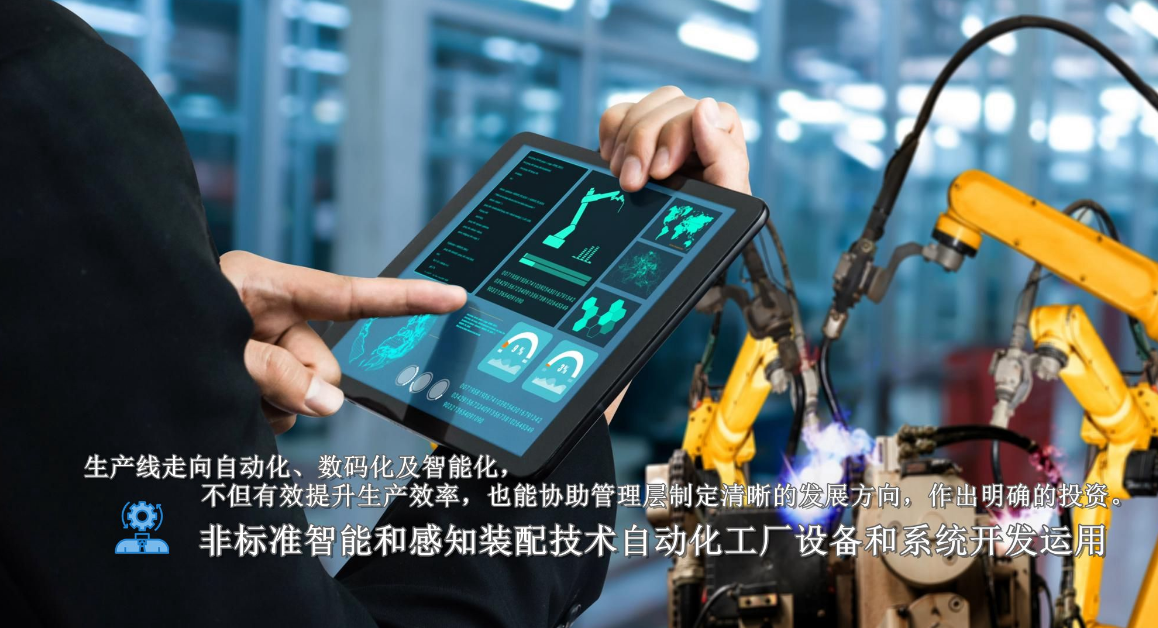
機器人裝配自動化工作站是現代制造業中實現高效、精準、柔性化生產的核心單元,它通過集成機器人技術、傳感器、視覺系統、自動化夾具及智能控制軟件,完成零部件的抓取、定位、組裝、檢測等全流程自動化。以下從核心組成、技術優勢、應用場景、設計要點及發展趨勢五個方面展開介紹:
一、核心組成
工業機器人本體
末端執行器(EOAT)
視覺與傳感系統
自動化供料系統
控制與軟件系統
PLC/工業PC:控制機器人運動、I/O信號及外圍設備。
離線編程軟件:提前模擬裝配路徑,減少現場調試時間。
MES/SCADA集成:與工廠管理系統對接,實現生產數據實時監控與追溯。
二、技術優勢
提升效率與一致性
降低人力與運營成本
增強生產柔性
支持精密與復雜裝配
微米級定位精度(如芯片貼裝、光學元件組裝)。
結合力控技術實現柔性接觸(如軟性電路板壓接)。
三、典型應用場景
3C電子行業
汽車制造
醫療器械
微創手術器械:精密零件插裝、激光焊接。
體外診斷設備:試劑卡組裝、液路系統連接。
家電與日用品
智能穿戴設備:表帶組裝、傳感器貼合。
玩具制造:塑料件插裝、裝飾件粘貼。
四、設計要點
任務分析與工位布局
安全防護設計
人機協作模式
可維護性與擴展性
采用模塊化設計,便于快速維修或升級。
預留接口以支持未來新增設備或功能。
五、發展趨勢
AI賦能智能化
通過深度學習優化裝配路徑,自適應調整工藝參數。
利用計算機視覺實現缺陷自檢測與分類。
數字孿生與虛擬調試
在虛擬環境中模擬工作站運行,提前發現設計缺陷。
結合AR技術實現遠程維護與培訓。
與增材制造融合
3D打印定制化夾具或復雜零件,縮短供應鏈周期。
實現“打印-裝配”一體化生產。

綠色制造集成
采用節能型機器人與低能耗傳感器。
優化供料系統減少物料浪費。
六、案例參考
特斯拉上海工廠:使用數百臺機器人完成電池模組、電機及車身的自動化裝配,單線產能提升3倍。
庫卡(KUKA)醫療裝配線:為骨科植入物生產提供高精度機器人裝配,公差控制在±0.01mm以內。
發那科(FANUC)協作機器人工作站:與人工協同完成電子產品柔性組裝,換型時間縮短至10分鐘內。
機器人裝配自動化工作站是制造業向“黑燈工廠”轉型的關鍵基礎設施,企業需根據自身需求選擇合適的技術方案,并注重長期可擴展性,以應對未來市場變化。
The robot assembly automation workstation is the core unit for achieving efficient, precise, and flexible production in modern manufacturing. It integrates robot technology, sensors, vision systems, automated fixtures, and intelligent control software to complete the full process automation of component grasping, positioning, assembly, and inspection. The following is an introduction from five aspects: core components, technological advantages, application scenarios, design points, and development trends:
1、 Core components
Industrial robot body
Type selection: Select different types of robots according to assembly requirements, such as:
Six axis articulated robot: suitable for complex trajectory movements (such as 3C product assembly, automotive component insertion).
SCARA robot: high-speed planar positioning (such as electronic component placement, small part sorting).
Collaborative robot (Cobot): works collaboratively with humans, safely and flexibly (such as precision assembly of medical equipment).
Load and accuracy: Select the robot model based on the weight of the parts and assembly accuracy requirements (such as load of 0.5-20kg, repeat positioning accuracy ± 0.02mm).
End of pipe actuator (EOAT)
Claw design: pneumatic/electric gripper, vacuum suction cup, magnetic suction, etc., suitable for different shaped parts (such as metal parts, plastic parts, brittle materials).
Force control module: integrates force sensors to achieve flexible assembly (such as preventing overvoltage damage to precision components).
Quick change device: supports quick replacement of jaws, suitable for multi variety production.
Visual and Sensing Systems
2D/3D Vision:
2D vision: used for part positioning and defect detection (such as QR code recognition and surface scratch detection).
3D vision: realizing posture recognition and guidance of complex structural parts (such as grasping irregular parts, surface fitting).
Laser ranging/infrared sensors: assist in positioning or safety protection (such as preventing robot collisions).
Automated feeding system
Vibration disk/flexible feeder: Batch conveying of small parts (such as screws, electronic components).
AGV/AMR: Automatically transport trays or pallets to workstations.
Intelligent warehousing: Combining RFID or barcode management of materials to achieve automatic replenishment.
Control and software system
PLC/Industrial PC: Control robot motion, I/O signals, and peripheral devices.
Offline programming software: Simulate assembly paths in advance to reduce on-site debugging time.
MES/SCADA integration: Integrate with factory management systems to achieve real-time monitoring and traceability of production data.
2、 Technical advantages
Improve efficiency and consistency
Robots work continuously 24 hours a day, with speeds far exceeding manual labor (such as completing hundreds of insertions per hour).
Eliminating human operational errors, the assembly qualification rate can reach over 99.9%.
Reduce manpower and operational costs
Reduce direct labor input, especially suitable for high-risk, repetitive, or harsh environmental operations (such as high-temperature, dusty workshops).
Reduce equipment downtime through predictive maintenance.
Enhance production flexibility
Quick changeover: supports multi variety mixed line production by adjusting the program or replacing the gripper.
Modular design: Workstations can operate independently or be integrated into larger production lines.
Support precision and complex assembly
Micron level positioning accuracy (such as chip mounting, optical component assembly).
Combining force control technology to achieve flexible contact (such as crimping of flexible circuit boards).
3、 Typical application scenarios
3C Electronics Industry
Assembly of mobile phones/tablets: screen fitting, camera module installation, button assembly.
Semiconductor packaging: wafer handling, chip bonding, wire bonding.
automobile manufacturing
Engine/transmission assembly: piston insertion, gear engagement, bolt tightening.
New energy vehicles: battery module assembly, electrical control system wiring.
medical device
Minimally invasive surgical instruments: precision component insertion, laser welding.
In vitro diagnostic equipment: reagent card assembly, fluid system connection.
Home appliances and daily necessities
Smart wearable devices: strap assembly, sensor fitting.
Toy manufacturing: plastic component insertion, decorative component pasting.
4、 Design points
Task analysis and workstation layout
Decompose the assembly process and determine the sequence of robot actions (such as grasping, gluing, pressing, and testing).
Optimize workstation spacing to avoid robot motion interference.
Security protection design
Install safety barriers and emergency stop buttons to prevent personnel from entering by mistake.
Collaborative robots need to pass ISO/TS 15066 safety certification.
Human machine collaboration mode
Clearly define the division of labor between humans and machines (e.g. robots are responsible for heavy physical labor, while humans are responsible for handling exceptions).
Design intuitive operating interfaces (such as touch screens, AR assistance).
Maintainability and Scalability
Adopting modular design for quick maintenance or upgrade.
Reserve interfaces to support future additions of devices or features.
5、 Development Trends
AI empowers intelligence
Optimize assembly paths through deep learning and adaptively adjust process parameters.
Utilizing computer vision to achieve defect self detection and classification.
Digital Twin and Virtual Debugging
Simulate workstation operation in a virtual environment to detect design flaws in advance.
Combining AR technology to achieve remote maintenance and training.
Integration with additive manufacturing
3D printing customized fixtures or complex parts to shorten the supply chain cycle.
Realize integrated production of "printing assembly".
twenty million two hundred and fifty thousand eight hundred and nine
Green Manufacturing Integration
Adopting energy-saving robots and low-energy sensors.
Optimize the feeding system to reduce material waste.
6、 Case reference
Tesla Shanghai factory: Using hundreds of robots to automate the assembly of battery modules, motors, and vehicle bodies, increasing single line production capacity by three times.
KUKA Medical Assembly Line: Provides high-precision robot assembly for orthopedic implant production, with tolerances controlled within ± 0.01mm.
FANUC Collaborative Robot Workstation: Collaborates with humans to complete flexible assembly of electronic products, reducing changeover time to within 10 minutes.
The robot assembly automation workstation is a key infrastructure for the transformation of the manufacturing industry into a "black light factory". Enterprises need to choose suitable technical solutions based on their own needs and pay attention to long-term scalability to cope with future market changes.